Showing posts with label history. Show all posts

Tuesday, January 31, 2006

Henry Ford II, saving the legacy of Ford Motor Company

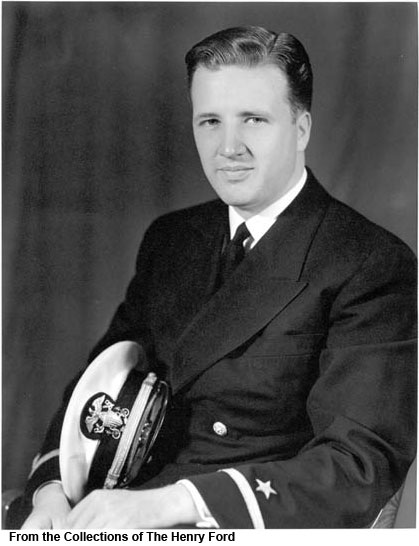
In the middle of World War II, Edsel Ford, the man who saved Ford Motor Company from is own father's destructive capricious nature passed away in 1943 from a rare form of stomach cancer. His oldest son was in the Navy, and by order of the government was released and sent back to Ford Motor Company. His grandfather Henry Ford I had resumed the presidency of the company in name, while his man Harry Bennet actually ran things in Dearborn.
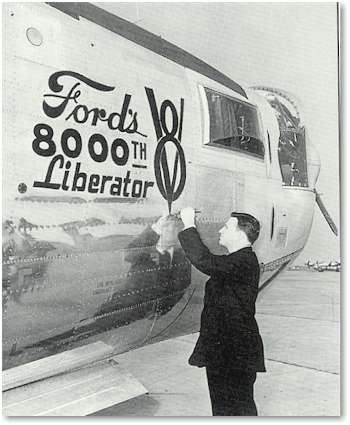
At one point, things were so dire at Ford, that the government tried to persuade Charles Sorenson, a long time Ford executive, who had been forced out by Henry I and Harry Bennet to come back and run the company for the government, so production of vital war materials would be continuos. Harry Bennet had so poisoned Henry I against his own grandson, that he held little power at Ford. That is until his mother and grandmother both pressured the old man to fire Bennet and allow young Henry II run the company.
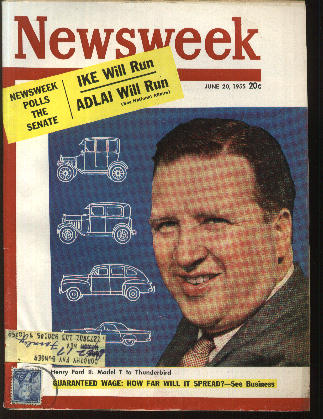
And while many though of Henry the "Deuce" untried and unproven, he did just that. Remarkably well actually, because he recognized his own shortcomings and brought in the right team of managers to get things done in a modern way. The Whiz Kids they were called. And in 1946 Ford was the first domestic automaker to bring out new models after the war.
Not like his grandfather, nor like his father, Henry II was his own man. And brought Ford Motor Company through some of the toughest and most prosperous times the industry would see.
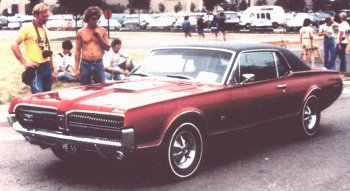
Here's a bit I found online, in 1967 Ford's Lincoln Mercury division had built prototypes called XR7S which became the production model XR7 and in 68 the Cougar Eliminator. The one pictured here was one driven by Henry II himself, and later bought by a Ford Employee who last showed it publicly in 1980. I wonder if this car still exists today?

I'm continuing reading Douglas Brinkley's book about the history of Ford, the family and company.

Unlikely friends you would think, Geroge Washington Carver and Henry Ford

With all that has been written about Henry Ford's Anti Semitism, you would assume that he is a biggot right? Wrong, his Anti Semitism aside and possibly discussed another time, Henry Ford was actually a very open minded, forward thinking and liberal man. This painting shows Henry Ford with George Washington Carver, the famous Agricultural Scientist and inventor of among other things Peanut Butter. Born the son of slaves the year after Henry Ford, Dr. Carver shared many interests and a friendship with Henry Ford. Both were keenly interested in agricultural chemistry, including bio fuels and alternative sources for rubber and plastic.
George Washinton Carver passed away in 1943 and Henry Ford in 1947, but until the end of their days, they remained friends and both worked in a field that we are revisiting today.
The Ford Family and Company still to this day donate to Tuskegee University where Dr. Carver did much of his research and taught.

Henry Ford, was a proponent of African American workers, never allowing segregation in his plants and always having the same pay and benefits regardless of race. I was also surprised to learn that ol' Henry was a supporter of the Sufrage movement for women's equality. It is my belief that despite his almost self destructive ego, at heart Henry Ford was a good man. His Anti Semitism, may have been born more from ignorance and frustration than actual experience.

But in the end, Henry Ford was one of the best friends African Americans had in the Industrial world.

World Car?

Henry Ford's dream of a "Universal Car" was realized for a time with the Model T. A car that sold globaly, and was built globally. But with the introduction of the Model A in 1928 something changed. European buyers were no longer flocking to Ford dealers, they were buying smaller Austin 7s and DMW Dixies. Ford needed to adjust to fit the market. Europeans wanted smaller more fuel efficient vehicles and despite Henry Ford's thiking a Ford Model A was not a "World Car." Governmental interferance and taxes actually resulted in the yearly tax on a Model A to be more than that of a Rolls Royce. So in 1932 Ford introduced a new car for Europe the Model Y. Smaller and with lower tax fees, it helped Ford survive in the new reality of the European car market. So Ford in the US and Ford Europe started to function as unique entities, both wholey owned by Ford, but with different missions. High fuel prices, smaller roads and lack of parking required that European Fords be smaller, lighter and more fuel efficient. Larger roads, longer distances, cheaper fuel and easier parking allowed US cars to grow and not stop. Today what we consider a "compact" car would actually be more akin to a midsize car in Europe.
It's amazing that you look at Fords in Europe and if you didn't see the blue oval badge, you wouldn't recognize it as a Ford. With few excpetions, European Fords haven't translated to the US market. I would guess that the Cortina was the first Euro Ford imported to the US in the 60's, and then the Capri in the 70's. And in the 80's Ford tried the "World Car" game again, with the Escort. The Escort had been a Euro model for about 15 years at the time, but it was not going to be imported this time, it would be built in the US, based on a European design. And unlike the Fiesta before it, it sold well. The US Escort was close but not exactly what the Euro version was, being larger and heavier, but it was a great start. The Escort was around for almost 20 years, before being replaced by the Focus, the Euro replacement for the Escort. Again built in North America, and altered to meet US Safety and Emisions standards.

With gas prices going up and down so drastically over the last year, talk has been that we need smaller more efficient vehicles. And word has been that Ford may again tap it's European model lineup. I look forward to this, but hope that some of these will be built here in the US.

Just a quick list of Fords that have been imported; Anglia, Cortina, Capri, Fiesta, XR4Ti (Sierra - UK) Scorpio (Granada - UK ) and just designs; Escort, Mondeo (Contour/Mystique) Focus.
I think it's correct that importing a design to be built locally has always allowed acceptance from US consumers, more than actually importing the vehicle.

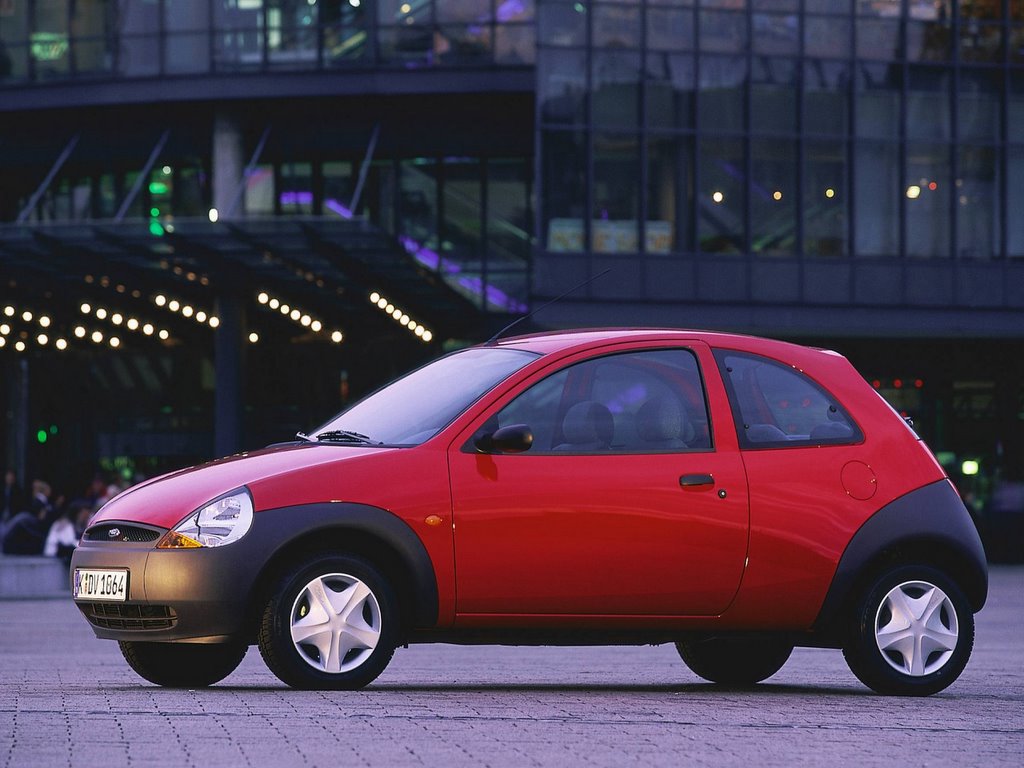
What European Fords would you want to see here? SAV, Galaxy, Focus, Mondeo, Ka, Fiesta, Fusion, Transit ????? Does it matter to you where it's built?

Friday, January 20, 2006

Alternative fuel technology nothing new for Ford

I always remember one thing my father told me "There are no more original ideas, everything has been thought of before." And you know what? He was right. Today, we talk about alternative fuels and electric vehicles as if they are new technologies. But in fact, some of the earliest "horseless carriages" were electric and steam driven. Henry Ford from day one concentrated on gas powered automobiles and early on was encouraged by the prompting of Thomas Edison to keep up his pursuit of gas powered automobiles. Edison knew what we know now, that the weight of the batteries and the limited range of electric vehicles would always be and issue.
Recently I have been reading a series of books on the life and times of Henry Ford and his companies. And some things were a major surpise to me. One of those things was the fact that even though Henry Ford was a proponent of the Internal Combustion Engine, even he recognized that Petrolium based fuels would, like the dinosours that they are derived from, cease to exist one day. So as early as 1916 Henry Ford started to research and support the use of corn and potato based alcohol fuesl such as Ethanol.
Now, this hit me like a sack of potatoes when I read it (sorry, I know, terrible pun.) But think about this, in 1916 Henry Ford was proposing Bio Fuels as a replacement for Gasoline!

Now I know old Henry had his faults, his ego and his bigotry among them. But it's undeniable that the man was a visionary, if not the genius he billed himself to be. 90 years ago, Ford Motor Company was looking into some of the same technologies that we are revisiting today. And another indisputable fact is that while there were hundreds of auto manufacturers over the years, Ford was one of the earliest and historically the most sucessful and inovative over the long run.

Another one of Henry Ford's projects was production using Soy based products. He envisioned soy based fabrics and early plastics and experimented for many years and invested heavily in Soy plantations. Love him or hate him, the man was a visionary.

And of course now Bill Ford jr, his great grandson, is trying to bring Ford back into the inovation business with some of those same ideas. Do any of you remember the Model U ? It was a concept vehicle from just a few years ago, and relied on some of these same ideas, of recyclable structure and alternative energy.

Just food for though.

Tuesday, January 03, 2006

How I spent my weekend, reading about Henry and Edsel Ford

A nice quiet weekend, and I spent most of it reading a book I received as a Christmas present. The Creation of the Ford Empire, Henry and Edsel by Richard Bak. A great read, and helped me realize how much I didn't know about Henry and his son Edsel. I had grown up thinking of old Henry as an inovator and simple genius and Edsel as a footnote in the Ford story. Nothing could be farther from the truth. Ford Motor Company was old Henry's third attempt at an Auto manufacturing company and the first that he had total control over. While it's true that Henry gave birth to the company, what I hadn't realized is that Edsel saved it more than once from his father's capricious nature.
While Henry was not highly educated, Edsel was, and quite adept at many things. But respectful of his father until the end, he was the man that really created the Ford Motor Company that we know today. Fighting his father's will to improve what he could at Ford, while running Lincoln, he finally persuaded his father to replace the Model T in 1928.
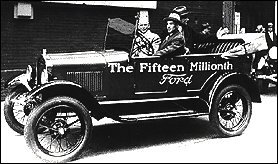
Ford Motor Company dominated the early years of the US auto industry, fully 75% of all cars on the road were Model Ts. And between 1908 and 1927 15,000,000 were sold. But by the last few years, Chevrolet was outselling Ford and others were eating market share. Old Henry didn't want to change from the Model T, it was Edsel that saved the company and helped stear it on the course towards the modern age.
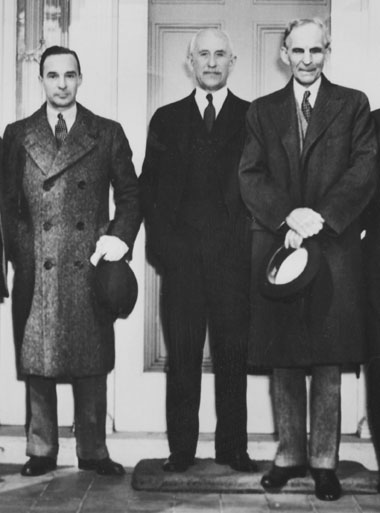
Henry Ford rubbed elbows with some of the greatest minds of the times, here he and Edsle flank Orville Wright. But it was Edsel that sought to diversify and expand Ford.
Here Edsel stands with Commander Byrd and William Stout beside a Ford TriMotor plane. Ford was not just a great businessman and engineer, but a patron of the arts and philanthropist. Edsel Ford financed Byrd's expedition and donated planes. William Stout had owned the company that Ford bought and worked for Ford.
Edsel Ford comissioned Diego Rivera to paint this famous mural at the Detroit Institute of Arts. Allowing Rivera access to the River Rouge plant, depicted here in the murals on four walls.
Rivera respected Edsel, and painted this portrait into the mural.
When most people hear the name Edsel, they think of the failed car bearing his name. That's a shame, because it was his legacy more than his father's that became the modern Ford Motor Company.

I can't retype the book here, but suggest anyone that has an interest in the history of Ford, and especially the son often overshadowed by the father. I cam away with a greater respect for Edsel and his son Henry II and a better understanding of Old Henry Ford. It put's into context his antisemitism and general bigotry. Old Henry was a complex man, yet in some ways very simple, who drove his only son to an early grave and almost destroyed his own company.

I hope to find more books about Edsel and possibly Henry II, but it seems that Henry II burned many documents to prevent such things.